Welcome back everyone! I will be sharing more about how the media can influence the public. In this blog post, I will be going in depth on what uses and gratification model is all about.
So, what is it?
It is used when people use media to gratify specific wants and needs. This model sees users as active participants who are motivated to take control of their media consumption.
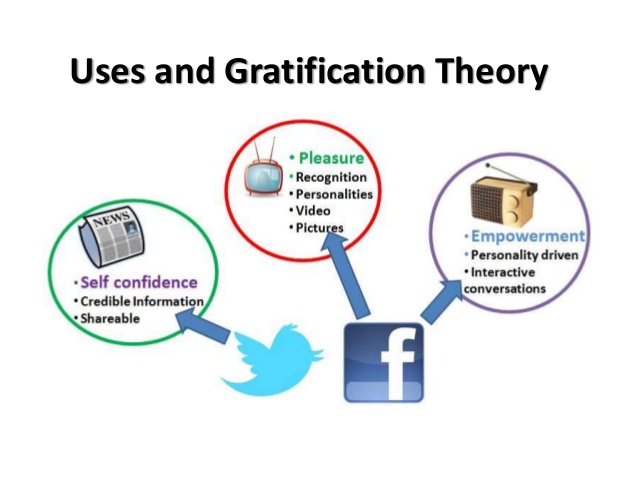
Uses and gratifications research has uncovered quite a number of motivations that people usually have for consuming media such as force of habit, companionship, relaxation, passing the time, escape, and information. Various studies have also been performed on different types of media, from radio to social media.
The 5 types of needs
Cognitive needs: People use media to find out for knowledge, information, facts, etc. Different people have different needs. For example, quiz programs on television give factual knowledge; to know about the current affairs, users need to watch the news regularly; search engines on the internet are also very popular since users can browse for any topic with ease.
Affective needs: It includes different types of emotions, pleasure and moods of people. People use media such as television, to satisfy their emotional needs. An example would be when a sad scene is being played, the audience will express emotions of sadness and they will tear up/cry.
Personal Integrative needs: This is the self-esteem need. People use media to reassure their status and to gain credibility. People can watch television and able to assure themselves that they have a respectable status in society. For example, when watching advertisements such as jewellery, furniture and apparel ads; those who are intrigued by those ads will buy the products so that they are able to have a change in lifestyles. And through this, the media has a part to play.
Social Integrative needs: It includes the need to socialise with family, friends and other important relations in society. In today’s world, it is uncommon to have weekly interactions in the form of gatherings as the use of social networking sites on the internet such as Facebook, Twitter, and Skype are able to satisfy what the people needs without spending much effort. Not only that, with the recently popular media service provider like Netflix, users can share up to 4 different devices in just one account. It is easier for users to stream TV shows and movies seamlessly on their devices and to share what are the latest shows to watch.
Tension free needs: People sometimes use the media as a means to “escape” from the real world and to relieve from tension and stress of everyday life. For example, people tend to relax and take their mind of f things while watching television, listening to songs on the radio, surfing the internet for retail therapy, etc. The media has an advantage of capturing the user’s attention as it resonates with their feelings and their current situation. However, different people will react differently to the media they are exposed to. For example, certain users will get a certain level of tension and stress while watching a football match whereas certain users will have a different emotion such as relaxation while watching it.
Case studies
The emphasis of individual differences has made researchers analyse how personality impacts one’s motivation for using social media. A study by the Virginia Polytechnic Institute and State University focuses on people who possess personality traits such as neuroticism and extroversion to know if there are people with different personality traits would associate with having different motives when watching television. Results show that those with neurotic personalities included passing time, companionship, relaxation and stimulation as their motivation. However, it is the exact opposite of those who have extraverted personalities. The conclusion drawn from this study is that the participants who have experienced social isolation or are introverts will tend to seek television as a form of communication whereas those who exerted an extroverted persona will argue that television is a poor substitution of human-to-human interaction.
Over the years, there have been discoveries of new media that are not found in the old media. As such, there are more choices of content and users will have the upper hand on what they want to interact with. An early study published in the journal CyberPsychology and Behaviour on uses and gratifications of the internet found seven gratifications for its use: information seeking, aesthetic experience, monetary compensation, diversion, personal status, relationship maintenance, and virtual community (as it has no other parallel forms of media). Another study that was published in the journal of Decisions Sciences, discovered three gratifications for internet usage. Two of these gratifications which are content and process gratifications had been found before in studies of the uses and gratifications of television. However, a new social gratification that is specifically for the use of the internet was also found. These two studies suggested that people seek the internet to satisfy their social and communal needs.
My thoughts
Having the upper hand and knowing that I am in control on how I consume media enables me to be aware of the decisions that I make and how it will affect my life and the people around me. I am conscious of the influence that the media has and I will be able to filter out the negative influences and utilise the positive aspects of media. With the increase in fake news in today’s world, I should always practise the habit of checking the sources so find out its credibility before believing it entirely.
Non-profit organisation
I would also want to share a few examples of an NGO (non-profit organisation) that I fully support which is WWF (World Wildlife Fund). Established in 1961, it aims to conserve and protect the natural environment by engaging people from all walks of life in making a positive change in their lives, in turn helping to protect the environment and its biodiversity.

There are many unique advertisements that sends powerful messages to the readers which WWF has come up with and here are some of them!

Denotation: Depicts a picture in a forest and a small girl wearing a tiger suit and a rifle was being pointed at her.
Connotation: the rifle, being the weapon is used to kill tigers in the forest
Mythic: Slogan reads “imagine this is yours” implies that if it is the same species as us, we will not kill it. It’s sending the message that tigers are being killed/poached for its physical attributes and it will soon be extinct.

Denotation: Depicts a man in mid-air who was jumping from a vine in a half empty forest.
Connotation: He was hoping to land on another tree, which he will land on the ground instead as there is no tree to support his fall.
Mythic: Sends a message that deforestation is rapidly inclining with evidence from the slogan “15 square kilometers of rain forest disappears every minute”. This will mean loss of livehood for animals, soil erosion, increase in greenhouse gases amongst many others.

Denotation: Depicts a seal sleeping on a bench with newspapers to act as blanket with run-down surroundings
Connotation: Seal was homeless, did not have proper place to live in and had to result in staying in a place it did not fit in, has to live in a human-like surrounding as its habitat is lost.
Mythic: A slogan that reads “you can help stop global warming”. Sends a message that due to the melting of ice caps in the north/south pole caused by environmental pollution, arctic animals are losing their livehood and are forced to seek shelter in places that they are not fit to live in.
Apologies for the lengthy post, but I hope it’s interesting read and to gain knowledge on the theory! Till next time, xx
References
Communication Studies. “Uses and Gratifications Theory.” 2019. http://www.communicationstudies.com/communication-theories/uses-and-gratifications-theory
Stafford, Thomas F. Maria Royne Stafford, and Lawrence L. Schkade. “Determining Uses and Gratifications for the Internet.” Decision Sciences, vol. 35, no. 2, 2004, pp. 259-288. https://doi.org/10.1111/j.00117315.2004.02524.x
Vinney, Cynthia. (2020, February 5). What Is Uses and Gratifications Theory? Definition and Examples. Retrieved from https://www.thoughtco.com/uses-and-gratifications-theory-4628333
Weaver, James B. III. “Individual Differences in Television Viewing Motives.” Personality and Individual Differences, vol. 35, no. 6, 2003, pp. 1427-1437. https://doi.org/10.1016/S0191-8869(02)00360-4
https://www.boredpanda.com/32-most-creative-wwf-ads/?utm_source=google&utm_medium=organic&utm_campaign=organic https://www.google.com/url?sa=i&url=https%3A%2F%2Fwww.slideshare.net%2Fnoraimaarif1%2F
uses-and-gratification-theory-59886774&psig=AOvVaw1487QCS8kMhwVJ0WgHwwqd&ust=1581260427620000&source=images&cd=vfe&ved=0CAIQjRxqFwoTCJjw46mcwucCFQAAAAAdAAAAABAS
https://www.communicationtheory.org/uses-and-gratification-theory/

 Aisah's Blog
Hey Aisah!
Well-written post that sufficiently covers the User & Gratification research and the 5 needs that gravitate the audience of media to choose a specific media text! Your input on the case study allows me to better understand how User & Gratification research understands the behavior of the audience based on what they choose to consume.
I agree that in today’s world, media are very much embedded in our lives but with the increase in faux news today it is easy for us to take it word for word without cross-referencing with other sources to determine its credibility. It is definitely crucial to practice the habit of confirming the credibility of the news we choose to consume. I particularly like how you interpret the image with the seal. Interesting insight!
Neat work! Look forward to working with you in class 🙂
LikeLiked by 1 person
Hiii Aisah!!! (couldn’t find your post before as you didn’t put the link in the google doc!!._.) It is a clear and informative post! The way you explain the 5 types of needs for people to use media is easy to understand. And I love the case studies part as it helps me know better on how the theory can be used.
I agree with you that fake news in today’s world are increasing as the technology is more advanced. There are many false information make us feel confused. It is good to have learnt more on media and to prevent being misled by those information.
The second image that you chose impressed me. It gives a strong message to people about seriousness of the situation of deforestation.
Looking forward to your next blog post!:D
LikeLiked by 1 person
Hiii Aisah!!! (couldn’t find your post before as you didn’t put the link in the google doc!!._.) It is a clear and informative post! The way you explain the 5 types of needs for people to use media is easy to understand. And I love the case studies part as it helps me know better on how the theory can be used.
I agree with you that fake news in today’s world are increasing as the technology is more advanced. There are many false information make us feel confused. It is good to have learnt more on media and to prevent being misled by those information.
The second image that you chose impressed me. It gives a strong message to people about seriousness of the situation of deforestation.
Looking forward to your next blog post!:D
LikeLiked by 1 person
Hey there Aisah! I have to say, your blog post is very aesthetically pleasant looking. Anyway, back to the topic at hand! I think you did a wonderful job with your description for the Uses and gratification theory, although it is an uncalculated coincidence that we happened to came across the same article! Moreover, I think you went a step ahead and gave us your personal thoughts on the issue and also you gave us a case study to support your discussion! A job well done! Lastly, your ‘lobby’ group example was a bit of a wake up call to everyone that comes across your blog! A deep message with a good analysis! Looking forward to more of your posts! Cheerio! #sorryforthelatereply
LikeLiked by 1 person